

Greece has over 200 inhabited islands. Most visitors see three or four, as they engage in Greek-Island hopping. That’s the right number. Greek Island hopping isn’t about collecting stamps. It’s about finding a rhythm — ferry, arrival, unpacking, wandering, repeat. Get the rhythm wrong and you spend your trip in transit. Get it right and you spend it in the water.
This guide covers the decisions that actually matter. Which islands to choose. How many days to give each one. How ferries really work, not how the brochures describe them. What to pack. What to skip. Every island looks perfect in photos. Not every island fits your trip.
First-timers make the same three mistakes. They pick too many islands. They underestimate ferry time. They book everything before they land. This guide fixes all three. Read it before you book a single ticket. It will save you money, time, and at least one stressful dock scramble at six in the morning.
Greece rewards planning. It also rewards flexibility. Those two things aren’t in conflict. You plan the frame. You leave the days inside it loose. That’s the whole method. Everything below builds toward that balance. Below, we offer a rudimentary Greek-Island Hopping Guide for tourists interested in navigating and exploring the Aegean.
Choosing Your Islands
Start with a region, not a list of names. The Cyclades, the Ionian, the Dodecanese, and Crete each have a different personality. Mixing regions on a first trip usually backfires. The ferries don’t connect well across them. You’ll waste a day for every region jump.
Pick one region. Choose three islands within it. That’s the formula for a first trip. Save the multi-region tour for your second visit.
The Cyclades: Best for First-Timers

This is the easiest region to string together. Ferries run often in summer. Distances are short.
Santorini. The famous one. Caldera views, whitewashed villages, dramatic sunsets. Fira and Oia sit stacked along a cliff edge left behind by an ancient volcanic eruption, with blue-domed churches and narrow stone lanes packed close together. Beaches here are volcanic — black and red sand instead of the pale gold found elsewhere in the Cyclades. Crowded and pricier than the rest, especially at sunset viewpoints in Oia. Best used as a two- or three-day finale, not a full-week base.
Mykonos. Known for nightlife and beach clubs. Little Venice hugs the waterfront with houses built right up against the sea, and the old windmills on the hill above town are the classic postcard shot. Beach clubs like Paradise and Super Paradise turn into loud, lounge-chair parties by afternoon. Good for travelers who want energy and social scenes. Skip it if you’re chasing quiet — it’s genuinely hard to find here.
Naxos. The largest Cycladic island. Mountain villages like Apiranthos and Halki sit inland, built from marble and stone, largely untouched by the beach crowds. The coastline runs long and sandy, with Plaka Beach stretching for kilometers of shallow, calm water. Far fewer crowds than its famous neighbors, and the food scene leans local — potatoes, cheese, and citrus grown on the island itself. A strong choice for a slower, three- or four-night stay.
Paros. Centrally located and well-connected by ferry. Parikia, the main town, has a labyrinth of whitewashed alleys built to confuse pirates centuries ago, and Naoussa, on the north coast, has a small fishing harbor that turns lively at night without Mykonos-level chaos. Golden Beach draws windsurfers for its steady wind. A walkable old town and an easy pace make it a good landing point early in a trip.
Milos. Known for volcanic coastline and lunar-looking beaches like Sarakiniko, where white rock formations meet impossibly clear water. Fishing villages like Klima have brightly painted boathouses built directly into the cliffside, doors facing the sea. Fewer ferry connections than Paros or Naxos, so plan around a slightly longer stay to justify the trip out.
The Ionian: Best for Green Scenery and Fewer Crowds
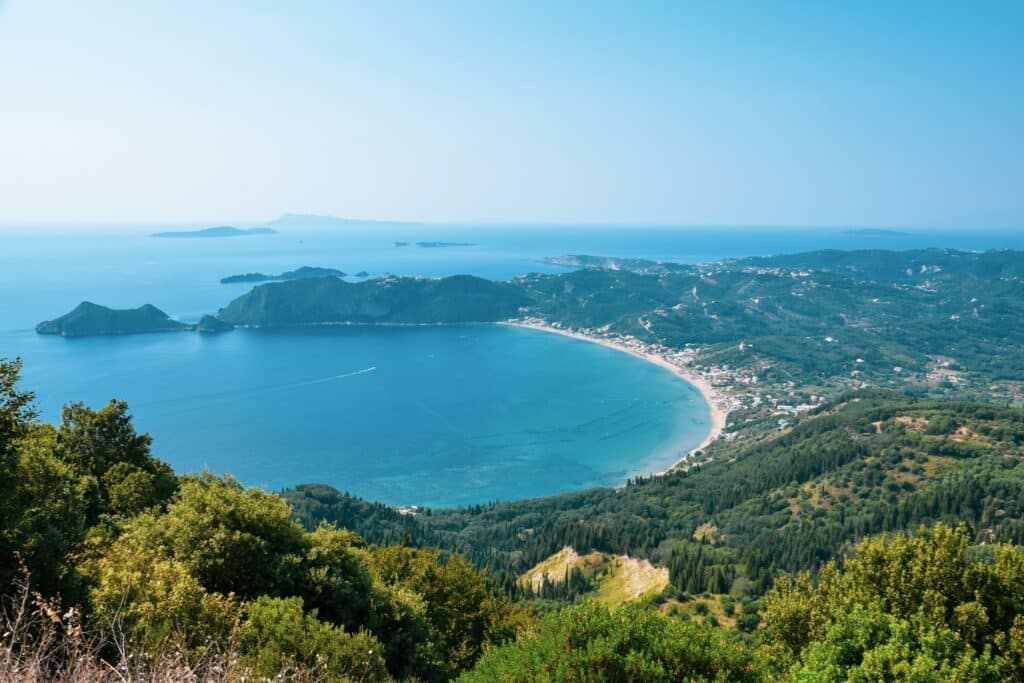
Ferry connections here are thinner. Plan around fewer, longer stops.
Corfu. Lush, forested, with a Venetian-influenced old town. Corfu Town is a UNESCO-listed maze of narrow streets, Italianate architecture, and old fortresses looking out over the Ionian Sea. The interior is genuinely green, more olive grove and cypress than the sun-bleached Cyclades. Good entry point for the region, with better flight and ferry access than the smaller islands nearby.
Kefalonia. Dramatic cliffs, turquoise water, and Myrtos Beach, one of the most photographed beaches in Greece — a crescent of white pebbles beneath sheer limestone walls. The Melissani Cave, a partially collapsed underground lake, is reachable by small boat and worth the detour. Renting a car here is close to essential, since the best spots are spread across a large, mountainous island.
Zakynthos. Home to Navagio, the shipwreck beach, reachable mainly by boat tour and framed by towering white cliffs on both sides. Sea turtles nest on some of the island’s southern beaches, and boat tours through the Blue Caves show off water so clear it looks lit from below. Quieter island life outside the main tourist stretch near the coast.
The Dodecanese: Best for History
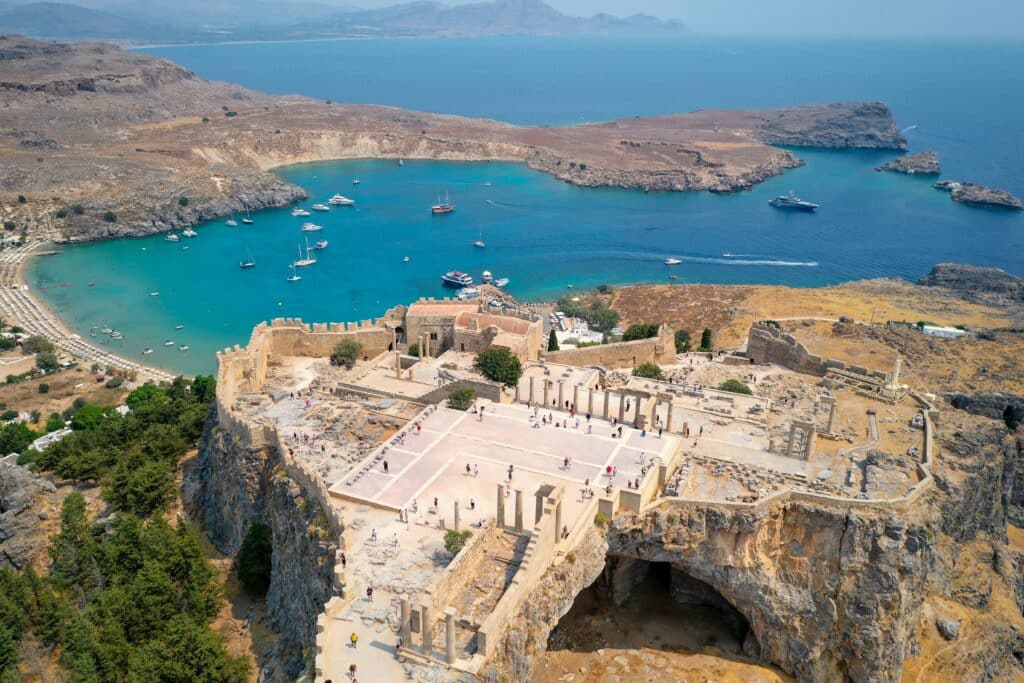
Ferries connect the region reasonably well, but it sits farther from Athens. Factor in a longer first flight or ferry leg.
Rhodes. A walled medieval old town, layered with Byzantine, Ottoman, and Italian history. The Street of the Knights and the Palace of the Grand Master sit inside massive stone fortifications that have stood since the Crusader era. Outside the old town, Lindos adds a hilltop acropolis overlooking a horseshoe bay. The most developed island in the region, with strong infrastructure for first-timers.
Kos. Flatter and more bike-friendly than Rhodes, with cycling paths connecting town to nearby beaches. Ancient ruins, including the Asklepion where Hippocrates is said to have taught medicine, sit alongside a relaxed beach-town feel and a lively harbor lined with cafes.
Symi. A small, pastel-colored harbor island, its neoclassical mansions climbing the hillside in shades of yellow, pink, and ochre above the water. Usually visited as a day trip from Rhodes rather than a standalone base, since ferry service is limited. Worth the detour if you have a free afternoon.
Crete: Best as a Standalone Trip
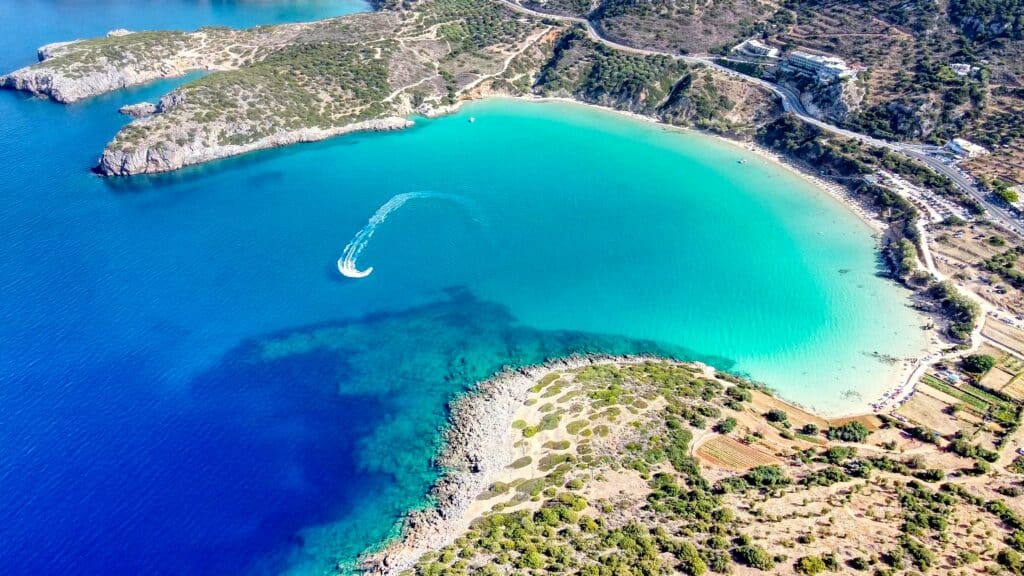
Crete is large enough to function as its own destination rather than one stop among several.
Chania. A Venetian harbor town with a walkable old quarter. The old harbor is lined with pastel buildings, a 16th-century lighthouse, and waterfront tavernas built into former Venetian arsenals. The nearby White Mountains and the Samaria Gorge, one of the longest gorges in Europe, make it a strong base for exploring the island’s western half.
Heraklion. Home to the Palace of Knossos, the legendary seat of the Minoan civilization and the source of the Minotaur myth, and the island’s main archaeological draw. The Archaeological Museum downtown holds much of what’s been excavated from the site. Less scenic than Chania, but central for history-focused travel.
Elounda and Agios Nikolaos. Quieter coastal towns on the east side, built around a small lake harbor in Agios Nikolaos and calm, protected bays near Elounda. The abandoned island fortress of Spinalonga, once a leper colony, sits just offshore and is reachable by short boat ride. Good for slower days and calmer beaches after a busier stretch elsewhere on the island.
Because Crete has strong internal transport, it doesn’t pair naturally with a multi-island Cyclades trip. Treat it as its own dedicated visit, not a fourth stop bolted onto another region.
How Many Islands, How Many Days
Three islands in ten days is a good starting ratio. That gives you three or four nights per stop. Anything shorter and you’ll spend more time packing than swimming.
Two islands in seven days works even better for a shorter trip. Rushing a third island just to say you visited it isn’t worth the ferry fare. Depth beats breadth here. A slow four days on Naxos beats a frantic two days each on three different islands.
Build in one buffer day near the end of the trip. Ferries get cancelled. Weather turns. A buffer day absorbs the disruption without wrecking your flight home. Skip this step and one bad-weather morning can cost you a missed international flight.
Understanding the Ferries
Ferries are the backbone of island hopping. They are not always punctual. Wind cancels routes, especially in July and August. High-speed catamarans cut travel time but cancel more easily than slower ferries. Slower ferries cost less and run more reliably in rough weather.
Book ferry tickets a few weeks ahead in peak season. Routes fill up between popular islands in July and August. Off-season, you can often buy tickets the day before. Don’t assume this flexibility applies to summer.
Check the departure port carefully. Some islands have more than one port. Piraeus, near Athens, is the main hub, but Rafina serves many Cycladic routes too, and it’s a different location entirely. Confirm your port before booking a taxi.
Arrive at the dock at least 45 minutes before departure. Boarding can be chaotic. Signage is sometimes unclear. Give yourself the buffer.
Where to Base Yourself on Each Island
Pick your accommodation location based on how you want to spend your days, not just the prettiest photos. A cliffside room in Santorini’s Oia looks stunning. It also means a steep walk to the port and back, every single time you move.
Choose a town center if you want walkability. Choose a quieter village if you want peace. Both are valid. Know which one you’re choosing before you book.
Check the walking distance to the port or bus stop. Photos never show elevation. A ten-minute walk on a map can be a twenty-minute climb in ninety-degree heat, hauling a suitcase.
What to Pack
Pack light. You’ll be on and off ferries, boats, and buses repeatedly. A hard-shell suitcase is a liability on cobblestone streets and narrow boat gangways. A soft duffel or a wheeled bag under airline carry-on size works better.
Bring a swimsuit you can wear two days in a row. Beach days come often and laundry access is limited on smaller islands. Quick-dry fabric is worth the extra cost.
Bring sturdy sandals, not just flip-flops. Many island paths are unpaved, rocky, or steep. Ankle support matters more than people expect.
Bring a portable charger. Some smaller islands have inconsistent outlet access in older buildings. A dead phone at a ferry dock is a real problem, not a minor inconvenience.
Leave the heavy hardcover novel at home. Bring a paperback or a tablet instead. Every extra pound matters when you’re carrying your bag up three flights of stairs to a hillside room.
Food and Money
Cash still matters on smaller islands. Card machines exist, but they don’t always work, especially at family-run tavernas. Carry enough euros for a full day, just in case.
Eat where locals eat, not where the menu has ten languages printed on the cover. A crowded taverna a few streets back from the harbor usually beats the empty one with the best view. The view costs a markup. The food doesn’t always match it.
Try the island specialty, not just the Greek salad. Naxos has its own cheeses. Santorini has fava made from local split peas. Every island has something specific worth ordering. Ask your host what it is.
Common Mistakes to Avoid
Don’t overbook your itinerary. Leave one unplanned afternoon per island. The best memories often come from wandering, not from the museum you rushed to see between ferries.
Don’t assume every island has an ATM. Smaller islands sometimes have just one, and it can run out of cash during peak season. Stock up before you leave a bigger island.
Don’t skip travel insurance. Ferry cancellations and missed connections happen more than people expect. A basic policy covers the cost of a scrambled rebooking.
Don’t judge an island by its main port town. Ports are often the least charming part of an island. The real character is usually a short bus ride away, in the smaller villages and quieter beaches.
A Sample First Trip
Start in Athens for two nights. See the Acropolis. Adjust to the time zone. Take the ferry from Piraeus.
Move to Paros for three nights. It’s centrally located, well-connected, and less crowded than its famous neighbors. Use it as your calm, easy landing point.
Move to Naxos for three nights. It’s the largest Cycladic island, with mountain villages and long beaches. Rent a car for one day and drive inland, away from the coast.
Move to Santorini for two nights. Save it for last. It’s the most photographed island for a reason, but it’s also the most crowded. Two focused days beat five overwhelmed ones.
Fly home from Santorini instead of ferrying back to Athens. It saves a full travel day and reduces the risk of a missed connection.
Final Thoughts
Island hopping rewards a light itinerary and a loose grip. The ferries won’t always run on time. The best meal might be at a place with no sign. That’s the trip working as intended, not going wrong.
Pick one region. Pick three islands. Build in a buffer day. Pack light. Carry cash. The rest of the details will sort themselves out once you’re standing on the dock with the sea in front of you.