

Milan, Italy, now the epicenter of the 2026 Winter Olympic games, has suddenly become the epicenter of international curiosity.
Milan is the city that dresses the world and whispers stories beneath its cathedral spires—where Gothic stone meets cutting-edge glass, and centuries-old frescoes rub shoulders with avant-garde boutiques. If you think Milan is only for fashion editors and business travelers, think again: it’s a mosaic of neighborhoods that feed curiosity, appetite, and the urge to wander.
Milan is full of contrasts that reward the attentive traveler. Whether you’re plotting a first visit or returning for a deeper dive, the city’s rhythm is both urgent and intimate: late-night theaters, early-morning markets, espresso-fueled meetings, and leisurely risottos that stretch into conversation. Knowing where to go, when, and why transforms these moments from pleasant to unforgettable.
In this article, we’ll not merely be exploring a list of landmarks, we’ll identify what makes Milan, Italy, a source of cultural resonance and importance. It’s your companion for making smarter choices: which neighborhoods best match your mood, how to navigate transport like a local, where to hunt for haute couture on a reasonable budget, and how to sequence your days so you leave with memories rather than exhaustion.
I. History
Milan is a city that defies the “museum city” trope of Italy by seamlessly weaving two millennia of history into a pulse-pounding, modern metropolis. Originally a Celtic settlement before becoming Mediolanum, a vital capital of the Western Roman Empire, the city served as the stage for the Edict of Milan in 313 AD, a turning point that legalized Christianity across the Western world. Through the Middle Ages and Renaissance, the city-state rose to artistic and military dominance under the Visconti and Sforza dynasties, who attracted luminaries like Leonardo da Vinci to decorate its halls and engineer its canals.
Today, as the global capital of fashion and a co-host of the 2026 Winter Olympics, Milan offers a unique sensory contrast: you can admire the gothic spikes of the Duomo, which took six centuries to finish, then walk five minutes to the Galleria Vittorio Emanuele II to witness the cutting edge of modern luxury. This “moral capital” of Italy is not just a gateway to the Alps or Lake Como; it is a sophisticated layers-of-time experience where Roman ruins, Leonardo’s Last Supper, and sleek glass skyscrapers exist in a perfect, high-speed harmony.
II. Cultural Importance
Often called Italy’s “Moral Capital,” Milan serves as the nation’s engine of innovation, work ethic, and global influence. While Rome is the seat of government, Milan is the seat of the future, balancing a gritty industrial history with a refined aesthetic that defines the Italian concept of bella figura (making a good impression). It is a city where culture is not just found in museums, but in the daily rituals of the aperitivo, the precision of its high-fashion ateliers, and its world-class opera tradition at Teatro alla Scala.
Milan is a unique city, bridging the significance of our past with optimism for the future.
III. Historical Sites
I. Santa Maria delle Grazie

The Church of Santa Maria delle Grazie is much more than a masterpiece of Renaissance architecture; it is a profound cultural sanctuary where the spiritual world meets the scientific precision of Leonardo da Vinci. A UNESCO World Heritage site, the complex represents the pinnacle of the Sforza dynasty’s patronage, featuring the grand tribune designed by Donato Bramante and the world’s most famous mural, The Last Supper.
Visiting this site is an essential pilgrimage for any traveler, offering a rare glimpse into the 15th-century “Milanese Renaissance” where art, engineering, and theology collided to change the course of Western history.
II. Duomo di Milano

The Duomo di Milano is the undisputed soul of the city, a breathtaking Gothic titan that took nearly six centuries and a dedicated marble quarry to bring to life. As the largest church in Italy, it serves as a “marble forest” composed of 3,400 statues, 135 spires, and a facade that shifts from pearly white to soft pink depending on the light. More than just a religious landmark, the Duomo is a symbol of Milanese perseverance and artistic ambition, surviving centuries of political upheaval and even the bombings of WWII.
III. Sforza Castle
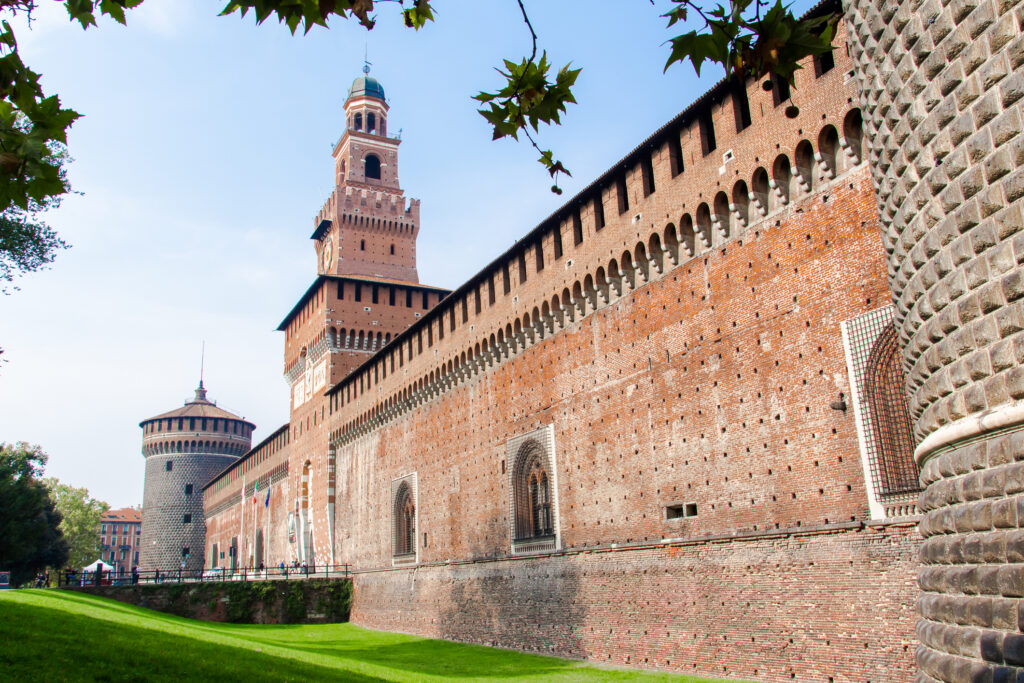
The Sforza Castle stands as one of the most imposing military-turned-cultural landmarks in Europe, serving as a red-brick testament to Milan’s turbulent and triumphant history. Originally built as a fortification in the 14th century by the Visconti family and later expanded into a magnificent princely residence by the Sforza Dukes, the castle has spent centuries as a symbol of power, a target for foreign invaders, and a playground for Renaissance masters like Leonardo da Vinci. Today, it has been transformed from a site of war into a sprawling museum complex that houses some of Italy’s most poignant artistic treasures, including Michelangelo’s final work.
IV. Teatro alla Scala

Teatro alla Scala is the world’s most prestigious opera house, a neoclassical temple of music where the legends of Verdi, Puccini, and Maria Callas were forged. Commissioned by Empress Maria Theresa of Austria and opened in 1778, the theater was built on the site of the former church of Santa Maria alla Scala—hence its name. While its exterior is famously understated, designed to blend into a narrow street, the interior is a dazzling horseshoe of red velvet, gilded wood, and six tiers of boxes surrounding a massive crystal chandelier. For over two centuries, La Scala has been the ultimate arbiter of Italian culture; its upper gallery, the Loggione, is home to the world’s most demanding critics whose approval can launch a career and whose boos can end one.
V. Brera District
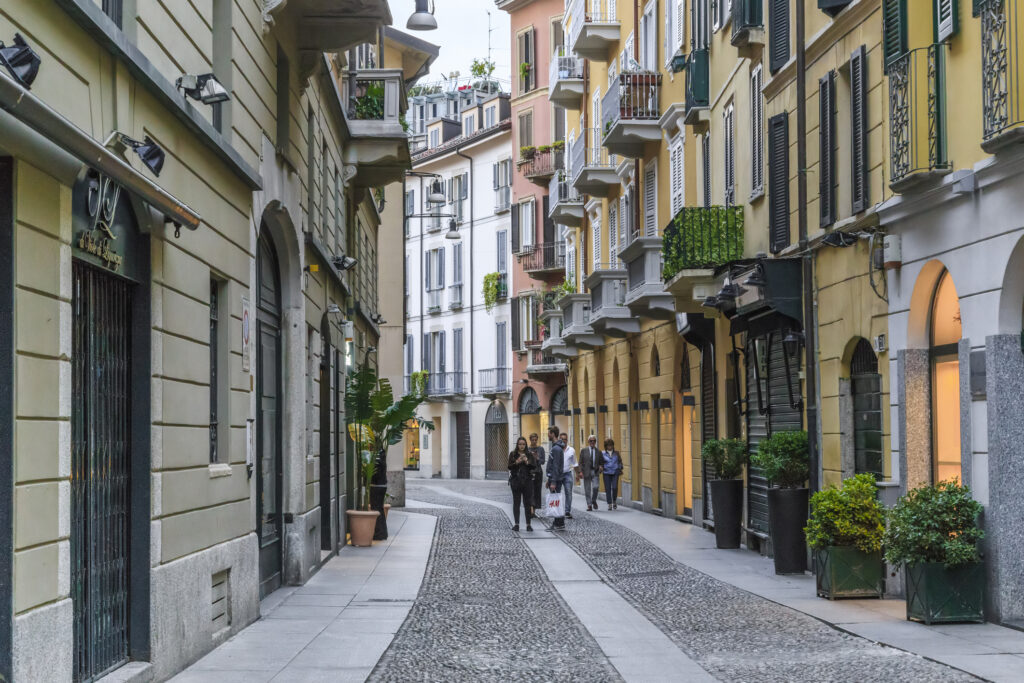
The Brera District is Milan’s “Artistic Heart,” a romantic maze of narrow, ivy-draped cobblestone streets that captures the city’s sophisticated, bohemian soul. Traditionally home to artists, students, and fortune tellers, the neighborhood is centered around the Palazzo Brera, a 17th-century Jesuit monastery that now houses a cluster of world-class cultural institutions. Today, Brera is the pinnacle of Milanese “understated luxury,” where centuries-old artisan workshops and antique bookstores sit alongside high-end perfumeries, sleek design showrooms, and chic galleries.
The atmosphere here is noticeably slower than the bustling center near the Duomo, making it the city’s premier destination for the aperitivo ritual—where locals gather at bars like N’Ombra de Vin or the historic Bar Jamaica to sip Negronis as the sun sets over the red-tiled roofs.
III. Food Recommendations
I. Dish: Risotto alla Milanese
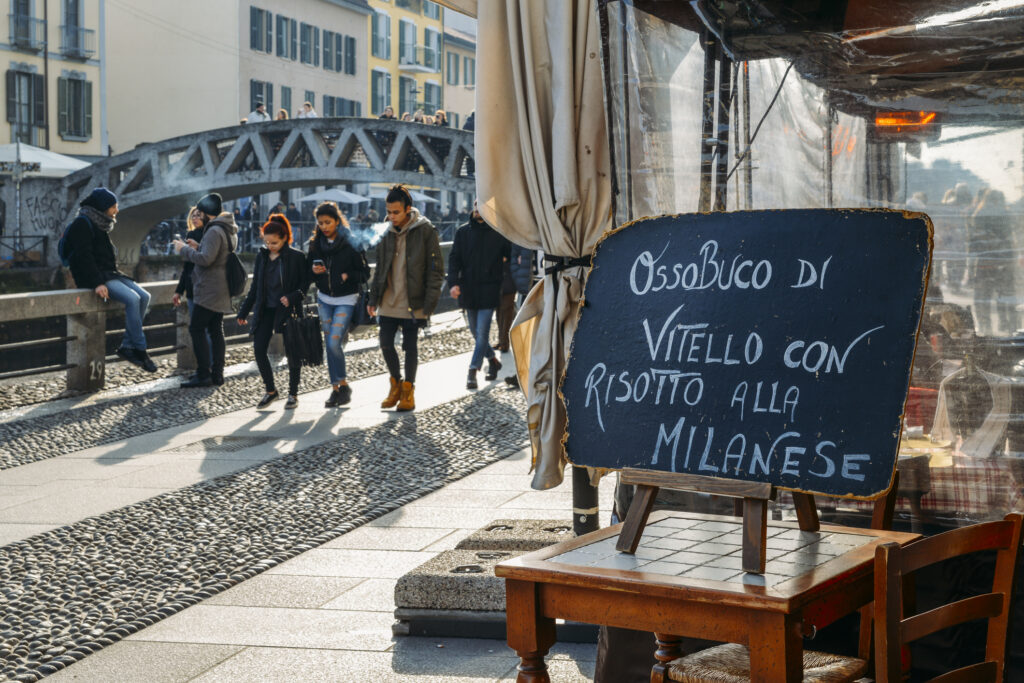
Unlike the pasta-heavy south, Milanese cuisine is defined by its “Yellow Gold”—Risotto alla Milanese. This iconic dish is a velvety, saffron-infused masterpiece that is as much a symbol of the city as the Duomo itself. Legend has it that the dish was born in 1574 when a young apprentice working on the Duomo’s stained-glass windows added saffron (then used as a pigment) to the wedding rice as a prank; the resulting golden hue and floral aroma were so spectacular that it became an instant local obsession.
Today, authentic risotto in Milan follows a strict ritual: it must be made with high-starch Carnaroli or Arborio rice, toasted in butter, and enriched with beef marrow (midollo) to create its signature unctuous depth. Whether served alone or alongside a tender, braised Ossobuco (veal shank), this golden bowl of comfort represents the refined, patient, and luxurious spirit of the Milanese table.
II. Dish: Ossobuco

While Risotto provides the golden glow of the Milanese table, Ossobuco is its soulful, robust heart. Often described as the ultimate Italian comfort food, Ossobuco alla Milanese consists of cross-cut veal shanks braised slowly with white wine, broth, and aromatic vegetables until the meat is tender enough to be eaten with a spoon. The name literally translates to “bone with a hole” (oss bus in local dialect), referring to the marrow-filled center that is considered the dish’s greatest delicacy.
Traditionally served in bianco (without tomato) and topped with gremolada—a zesty herb relish of lemon zest, garlic, and parsley—this dish offers a perfect balance of rich, melt-in-your-mouth fats and bright, acidic highlights. In the culinary landscape of 2026, it remains the essential “Sunday lunch” for locals and a must-try for any traveler seeking the true taste of Lombardy.
IV. Most Insta-grammable Spots
I. Galleria Vittorio Emanuele II
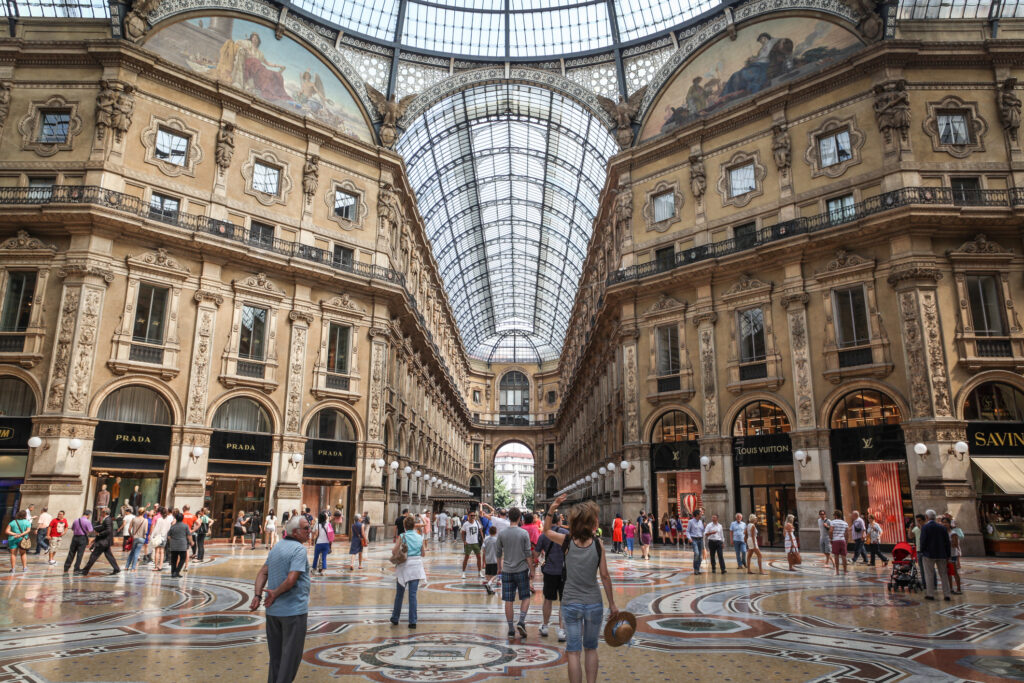
Known as “Il Salotto di Milano” (Milan’s Drawing Room), the Galleria Vittorio Emanuele II is one of the world’s oldest and most majestic shopping arcades. Completed in 1877, this four-story double arcade is a triumph of 19th-century engineering, featuring a revolutionary iron-and-glass roof and a massive central dome. It serves as a literal and symbolic bridge between the Duomo and Teatro alla Scala, housing global fashion flagships and historic cafés beneath neoclassical facades. Even today, it remains the ultimate venue for the “see and be seen” lifestyle, where architectural grandeur makes every stroll feel like a historic event.
II. Navigli District
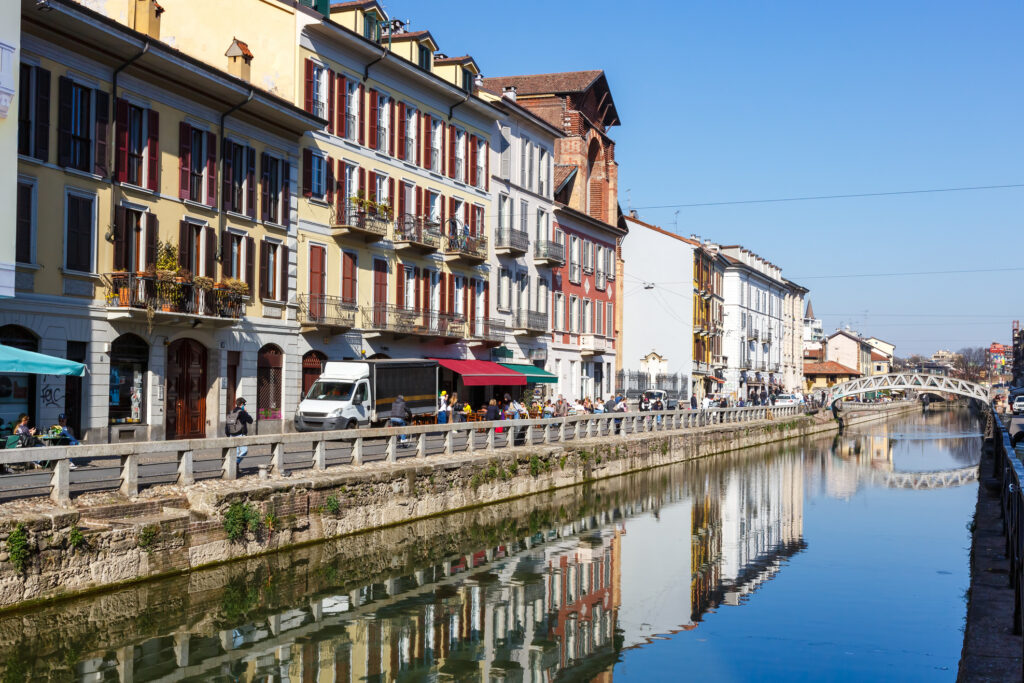
The Navigli District is Milan’s vibrant canal quarter, a picturesque neighborhood where the city’s ancient engineering meets its modern, bohemian spirit. Originally built as a vast network of navigable waterways to transport goods and the heavy marble used for the Duomo—with systems of locks famously perfected by Leonardo da Vinci—the district has evolved into the spiritual home of the Milanese aperitivo. Centered around the Naviglio Grande and Naviglio Pavese, the area is lined with historic “case di ringhiera,” artisan workshops, and vintage boutiques. As the sun sets, the reflection of colorful facades and fairy lights on the water creates a magical atmosphere, drawing locals and travelers alike to its waterside bars and restaurants.
III. Piazza Gae Aulenti
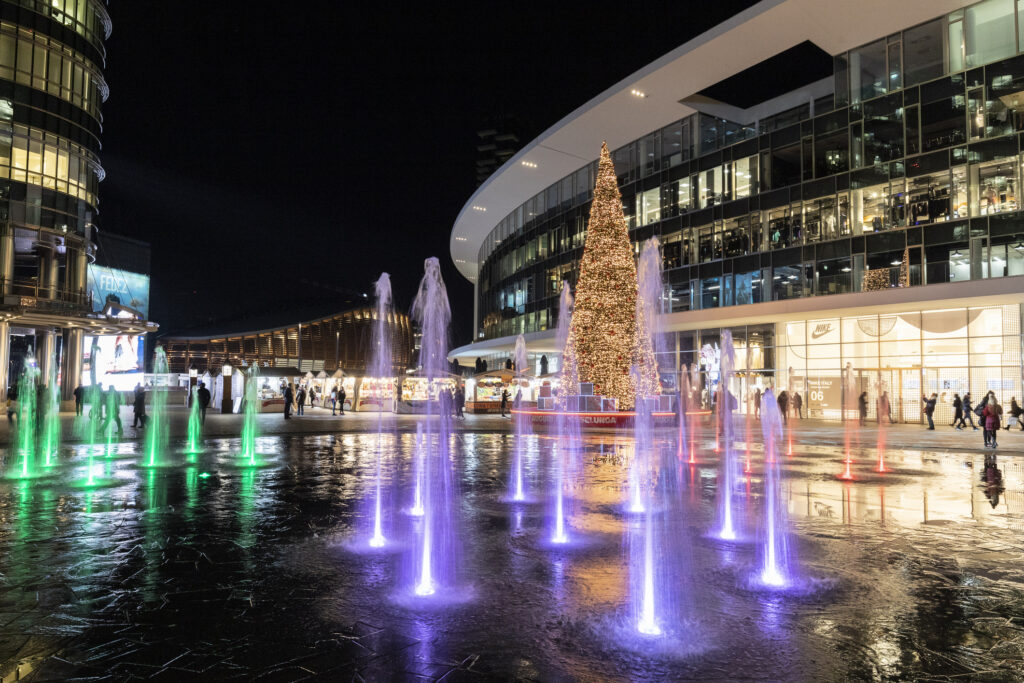
Piazza Gae Aulenti is the futuristic heart of Milan, representing the city’s 21st-century “New Renaissance” and its status as a global capital of design and finance. Named after the legendary Italian architect Gae Aulenti, this circular, elevated podium is surrounded by a ring of sleek, glass-and-steel skyscrapers, including the soaring Unicredit Tower, Italy’s tallest building. The piazza is celebrated for its sustainable urban design, featuring reflective water pools and solar-powered “trees” that illuminate at night.
IV. Pinacoteca di Brera

The Pinacoteca di Brera is Milan’s premier public gallery for Italian paintings, housed within a magnificent 17th-century Palazzo that feels like the intellectual soul of the city. Established by Napoleon Bonaparte as a “Louvre of Italy,” the museum boasts a world-class collection featuring masterpieces by Raphael, Caravaggio, and Piero della Francesca.
